Politics of Cuba and Communism
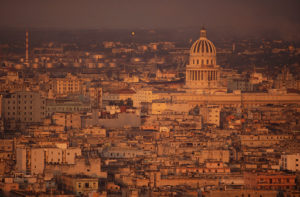
Cuba has had, according to the Constitution, a democratic centralist political system since 1959 based on the “one state – one party” principle. The country is constitutionally defined as a Marxist Leninist (socialist state guided by the political ideas of Marx. The present Constitution also ascribes the role of the Communist Party of Cuba to be the “leading force of society and of the state” and as such has the capability of setting national policy.
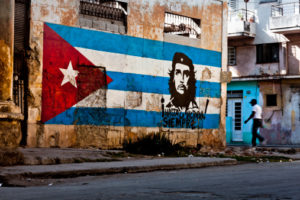
The Communist Party remains in power, the state dominates the economy, and murals depicting the face of the long-dead revolutionary Che Guevara still appear on city walls. Predictions that the island would undergo a rapid transformation in the manner of China, let alone the Soviet bloc.
Executive power is exercised by the Cuban Government, which is represented by the Council of State and the Council of Ministers. Legislative power is exercised through the unicameral National Assembly of People’s Power, which is constituted as the maximum authority of the state. Currently Raúl Castro—brother of ex-president Fidel Castro.
Officially, Cuba considers itself a “people’s democracy”, as opposed to the “liberal democracy”. Cuba thus rejects criticism of its political system as a lack of apprehension for different forms of democracy other than those in capitalist states.
Opposition groups inside and outside the country as well as international NGOs and foreign governments have described the Cuban political system as undemocratic.
The Cuban political system is normally described as undemocratic by human rights groups and academics and is usually classified as a dictatorship, one-party state or a totalitarian state.
Cuba is the only authoritarian regime in the Americas, according to the 2010 Democracy Index. Cuba’s extensive censorship system was close to North Korea on the 2008 Press Freedom Index.
Cuba’s reforms might appear frustratingly slow, inconsistent, and insufficient to address its citizens’ economic difficulties and desires for greater political participation. Although important, the expansion of the small-business sector cannot resolve these core issues. There are now 181 legal categories for self-employment, but they are concentrated almost exclusively in the services sector, including proprietors of independent restaurants, food stands, and bed-and-breakfasts.
The 2013 Transparency International Corruption Perceptions Index ranked the Cuba 58th out of 166 countries, and therefore has lower levels than most of the other countries in the Caribbean and Central America.
Hi, this is a comment.
To get started with moderating, editing, and deleting comments, please visit the Comments screen in the dashboard.
Commenter avatars come from Gravatar.